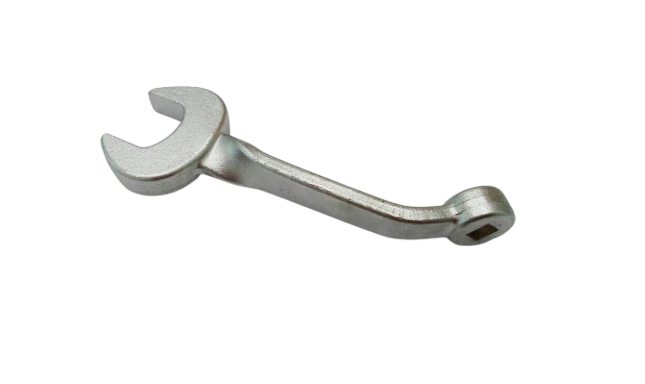
CHLORINE CYLINDER/DRUM WRENCH
The purpose of this specification is to describe the requirements for chlorine wrench used at Water Corporation sites where chlorine drums or cylinders are connected for use. This specification applies to spanners used at Water Corporation chlorine facilities for drum or cylinder connection/disconnection and is mandatory. Spanners other than the multi chlorine spanner shall not be employed. The chlorine wrench is a standard designed tool, for use by authorised/trained personnel, for connecting and disconnecting chlorine drums and cylinders. The Chlorine wrench has a unique twisted feature and is angled to allow the operator to apply reasonable force to open spindle valves.
A Chlorine Mallet can be employed where the use of a hand is insufficient. Note: The new Aluminium/Bronze/Silicon spindle valves on chlorine drums and cylinders are not as tight as the previous mild steel spindle valves. The large open end of the Chlorine wrench is used to remove or replace the valve outlet cap nut. NOTE: Never attempt to open or close the valve gland nut by any means.
The small open end of the Chlorine wrench can be used for loosening the bolts that secure the spindle valve protective cover on a chlorine drum. NOTE: In some cases, instead of bolts, the valve protection cover has also been reported to be secured by small chocks of wood. The square cut out on the Chlorine wrench is used for opening and closing the gas or liquid spindle valve on a chlorine drum or gas spindle valve on a chlorine cylinder. NOTE: After the initial opening of a chlorine drum or cylinder with the standard Multi Chlorine Spanner it should be replaced with the standard Chlorine Valve Key on each of the spindle valves of a chlorine (drum GAS) withdrawal system OR on each auxiliary valve (pigtail isolation valve) of a chlorine (drum LIQUID) withdrawal system OR on the spindle valve of a cylinder that is connected to allow for quick and easy closure in the event of a chlorine leak. The only exception to this is where an ESD is in use as they obstruct the use of a key